

Our services
Skylights and flat glass roofs in Makkah and across Saudi Arabia
A skylight is a glass roof or roof opening that brings daylight into stairwells, light wells and halls. Qusoor Al-Sultan builds flat skylights on an aluminium frame with laminated glass, to each project’s roof drawings, from SAR 1,080/m² supplied and installed, before VAT, in Makkah.
What do we need to design a skylight?
Knowing that a project needs a glass roof is not enough. We need information showing where the glazing sits and how it meets the roof around it: roof drawings, the location of the opening and its available dimensions, its divisions in the design, sections and specifications, and site photos with the current stage of the project.
Roof lights for flat roofs: more than a window in the roof
A skylight belongs to the roof and the area it glazes, not to a vertical opening. So we review the whole chain: roof opening, area dimensions, glazing, aluminium components and support, then the elements around it. The scope may be one glazed opening or a larger glass roof, and the design of the project sets each case. Roof sky lights, rooflights or roof lights: whatever you call them, we build them flat, with a fall for drainage. Each is a custom skylight made to the roof drawings, and the flat shape suits regular openings, square or rectangular, small or large.
Which glass goes into a roof skylight?
Laminated glass, in both of our grades, because it holds together if broken and does not fall onto the occupied space below. The glass also sets how much light and heat the roof admits, so it is chosen by position, not looks: over kitchens and heat sources, a different glass and a ventilation review may be needed. If you were looking for a double glazed skylight, note that both of our published grades use laminated glass rather than a double glazed unit; heat is managed through the glass treatment, such as reflective tinted glass at SAR 36/m², and the orientation of the opening.
Safety comes before appearance, checked against the Saudi Building Code and the project specification. For glass types in detail, see architectural tempered glass; for the same safety reason, laminated glass is also used on glass railings.
Smart or SG 50: the two aluminium skylight grades and what they include
Flat skylights run on the same Alupco systems as our facades: Standard (Smart system) from SAR 1,080/m² and Premium (SG 50) from SAR 1,145/m², within a published range of SAR 1,080–1,195/m², supplied and installed, before VAT, in Makkah. Both include laminated glass, the aluminium frame and, where needed, a steel chassis under the roof. Reflective tinted glass adds SAR 36/m².
Outside Makkah, transport and installation add 3% to 10% by city. Indicative lead time: 21–28 working days from approved shop drawings to handover for under 50 m², rising with area. Every range is listed in our aluminium and glass price guide.
Skylight uses in homes, kitchens and commercial buildings, and how one is built
| Type or shape | Description | Suits | What is checked |
|---|---|---|---|
| Stairwell and light-well skylight | Brings daylight into the stairwell | Villas and homes; one of the most requested uses | Opening size, ceiling height and access for washing later |
| Kitchen and interior skylight | A glass roof above a heat source | Kitchens and interior dining halls | Ventilation and heat; a different glass may be needed |
| Flat | The shape we build, and the simplest to execute | Regular openings | A fall sufficient to drain water and stop dust settling |
| Tempered versus laminated | Laminated holds together if broken | Overhead panes above occupied space | Safety before looks, per the building code and specification |
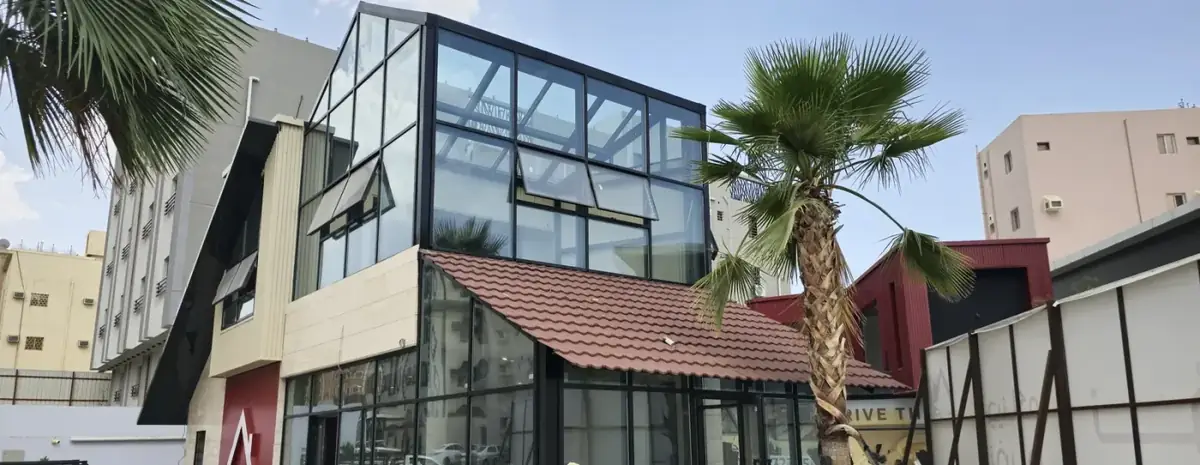
In villas and homes, the stairwell is one of the most requested places for residential skylights, and a skylight can also bring daylight into a living room or an entrance hallway. Over a kitchen, heat and ventilation decide the glass. Commercial skylights are built in the same steps, as on the Karz Al-Bon commercial building pictured below. As skylight contractors with our own factory in Makkah, we supply and install them across Saudi Arabia.
How a skylight is built, step by step
- Review the opening drawing, its dimensions and the structure around it.
- Set the falls and the drainage route.
- Prepare the frame and the glass at our factory in Makkah.
- Install, then seal the junctions with the roof.
If your project is a vertical glass facade rather than a roof, see structural glazing or curtain wall, depending on the system specified.
Skylight in your project?
Send the roof drawings you have
Even part of them is enough to start, with the BOQ if there is one, the project city and its current stage.
Frequently asked questions
What is a skylight?
A skylight is a glass roof or opening built into a building’s roof to bring natural light into an interior space. We build it flat only, with a fall for drainage, on an aluminium frame, and its price includes laminated glass and any support needed under the roof.
How is a skylight different from a clerestory window?
A skylight is a glazed opening within the roof, while a clerestory is a vertical opening high in a wall. A skylight is therefore studied from the roof drawings and the area to be glazed, and it needs a sufficient fall to drain water and stop dust from settling.
Do larger glass roofs need different information?
No. They need the same information as a standard skylight: roof drawings, the opening location, available dimensions, sections and specifications, and site photos. The difference lies in the extent of the area, its divisions and how it relates to the surrounding roof design.
How is water kept out of a skylight?
With a fall that sheds water away from the joints and a clear drainage route on the roof, both settled on the drawing before fabrication, then by sealing the junctions between the skylight frame and the roof at installation. That is why the work starts from the roof plan, not from the opening size alone.
Should a glass roof use toughened or laminated glass?
Laminated. Every skylight we build uses laminated glass in both grades, because a broken pane holds together instead of falling into the occupied space below, unlike toughened glass roof panels on their own. The project specification and the Saudi Building Code have the final word, and over a kitchen a different glass may be needed.
How much does a skylight cost in Saudi Arabia?
A flat aluminium skylight costs SAR 1,080–1,195/m², supplied and installed, before VAT, in Makkah: from SAR 1,080 on the Standard grade (Smart system) and from SAR 1,145 on the Premium grade (SG 50), both with laminated glass. Reflective tinted glass adds SAR 36/m². Outside Makkah, transport and installation add 3% to 10%, for example 8% for a project in Riyadh.
What are the best skylights for flat roofs?
For a flat roof, choose a flat skylight on an aluminium frame with laminated glass, laid to a fall that sheds water and sealed to the roof at installation. Laminated glass holds together if broken instead of falling into the room below. Ours start from SAR 1,080/m² (Smart) or 1,145 (SG 50), supplied and installed, before VAT, in Makkah.
What should you check when comparing skylight contractors?
Check that the offer is based on your roof drawings, with falls, drainage and junctions with the roof settled before fabrication, and that laminated glass, the aluminium frame and any support needed under the roof are included. Ask for the indicative lead time: ours is 21–28 working days for under 50 m². Main contractors can start from our contractors page.
What should I ask about skylight light and heat before approval?
Ask about the glass type and its treatment, the orientation of the opening and its area relative to the space below, because a skylight brings in heat along with light. Over kitchens and heat sources, ventilation and heat need review and a different glass may be required. Do not compare offers by area alone.
Technical review: Eng. Hisham, factory manager at Qusoor Al-Sultan, with more than 20 years of management and technical experience in aluminium and glass. He reviews the technical content of this page. Last updated: 8 October 2026.